Oculoplastic Surgery
Ptosis (Drooping Eyelid Surgery)
- Fast-tracked appointments available
- 0% finance
What Is Ptosis?
Overview
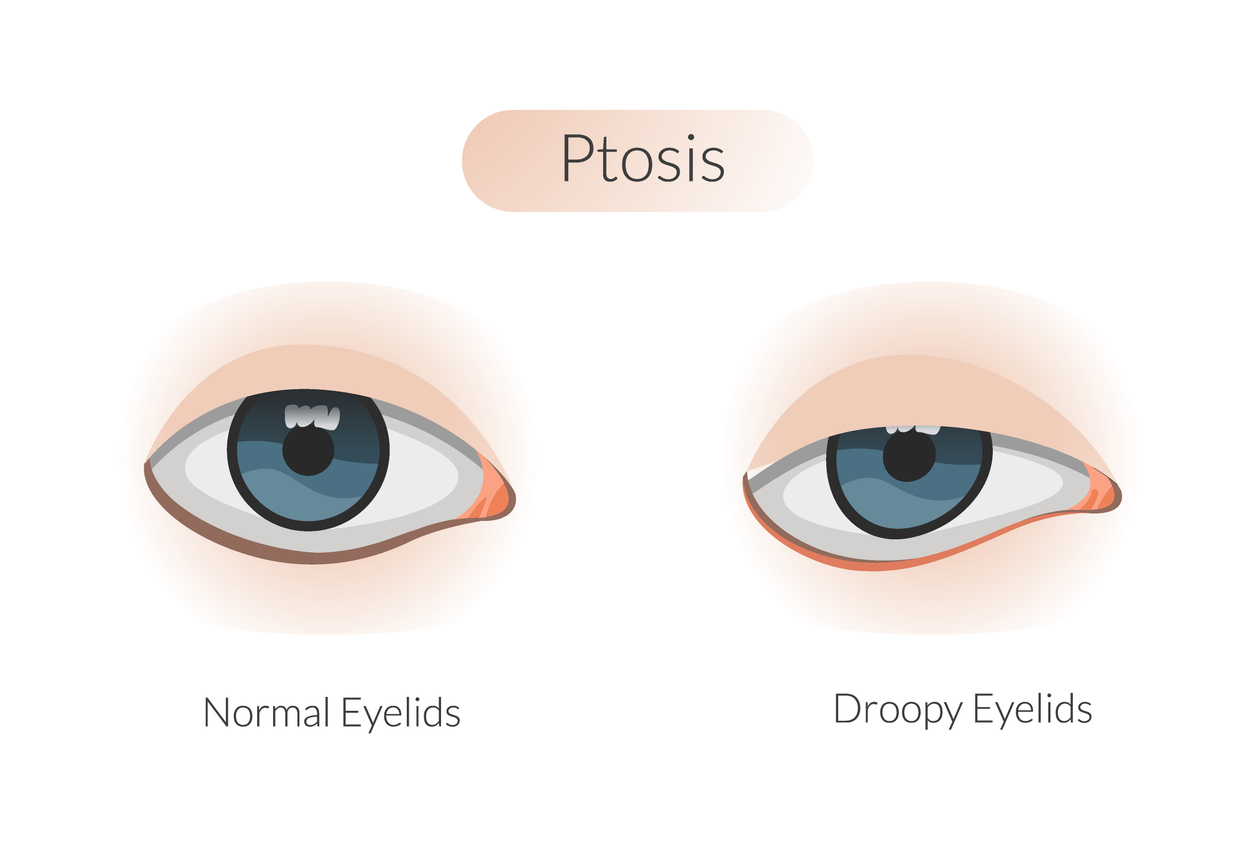
Ptosis (pronounced ‘toe-sis’) is the medical term for drooping of the upper eyelid. The lid may droop only slightly or, in more significant cases, may partially or fully cover the pupil — reducing the visual field and making everyday activities such as reading, driving, and working at a screen more difficult.
Ptosis can develop at birth (congenital ptosis) or at any point during life (acquired ptosis). Regardless of the underlying cause, ptosis warrants specialist assessment — particularly when it is new, unexplained, or progressive, as it can occasionally indicate an underlying neurological or systemic condition.
Our Services include:
What Causes Ptosis?
Aponeurotic ptosis
The most common type in adults. The levator aponeurosis — the tendon connecting the eyelid-lifting muscle to the lid plate — stretches or partially detaches with age or following prolonged contact lens wear. The muscle still functions well, but its action is poorly transmitted to the lid.
Myogenic ptosis
Weakness or disease of the levator muscle itself, sometimes associated with conditions such as myasthenia gravis or chronic progressive external ophthalmoplegia.
Neurogenic ptosis
Caused by disruption to the nerve supply of the eyelid, including Horner's syndrome or third cranial nerve palsy. A newly presenting neurogenic ptosis always requires urgent investigation.
Mechanical ptosis
The weight of a lid tumour, cyst, or excessive skin physically holds the eyelid down.
Congenital ptosis
Present from birth, typically caused by incomplete development of the levator muscle. Early surgical management is often required to prevent amblyopia (lazy eye) in young children.
Eyelid Muscle Tightening
In most cases, the muscle that lifts the eyelid is still working reasonably well — it just isn’t connecting to the lid as effectively as it should, usually because the tendon attaching it has stretched or slipped over time.
Ptosis can be corrected anteriorly (through the skin) or posteriorly (under the eyelid with no skin incision). Mr Kamalarajah will recommend which of one these procedures would be suitable for you.
For the anterior approach, Mr Kamalarajah corrects the ptosis through a small incision made along the natural crease of the eyelid, re-securing the tendon so that the muscle can lift the lid properly again. A skin blepharoplasty is usually also performed at the same time. The resulting scar sits within the existing skin fold and is virtually undetectable once healed.
For the posterior approach, the incision is made through the inner lining of the eyelid and the tendon is tightened with a couple of dissolving sutures. There is no visible skin scar with this procedure. This approach is usually used when there is minimal excess eyelid skin.
Brow Suspension Surgery
Where the muscle that lifts the eyelid is very weak or not working at all, a different approach is used.
A small, soft silicone sling is placed just beneath the skin to link the eyelid to the forehead muscle, which is much stronger. This allows the eye to open by gently raising the brow — something most people do naturally without even noticing. The procedure uses only a few tiny incisions and leaves minimal scarring.
Meet your Surgeon

Mr Sri Kamalarajah
Consultant Ophthalmic Surgeon & Glaucoma Specialist
Mr Sri Kamalarajah is a Consultant Ophthalmic Surgeon with a specialist interest in oculoplastic, lacrimal and orbital surgery.
With over 20 years of experience in the field, he brings a wealth of expertise to every procedure he performs at Cathedral Eye Clinic.
Your Patient Journey at Cathedral Eye Clinic
Detailed Consultation
Your consultation with Mr Kamalarajah will include a thorough assessment of your eyelids and a discussion about how ptosis is affecting your vision and appearance. He will explain the cause of your ptosis, talk you through the treatment options available, and discuss the results you can realistically expect from surgery. If any further investigations are needed, these will also be arranged.
Day of Surgery
Ptosis surgery at Cathedral Eye Clinic is performed as a day-case procedure. In adults, surgery is carried out under local anaesthetic — which has the important advantage of allowing Mr Kamalarajah to sit you upright during the procedure to assess lid height and symmetry in real time, ensuring the most accurate result possible. You will be cared for by our team throughout your time in clinic and discharged with written aftercare instructions.
Aftercare & Follow-Up
Following ptosis surgery, you will be seen at a post-operative review to assess lid height, symmetry, and corneal health. Minor adjustments to lid position can sometimes be made at this early stage. If a small degree of over- or under-correction is present, a further procedure may on occasion be recommended — this is not uncommon in ptosis surgery and reflects the inherent variability of tissue response rather than any complication. Our team will support you throughout your recovery.
To arrange a ptosis assessment with Mr Sri Kamalarajah at Cathedral Eye Clinic Belfast, contact us to book your consultation.
Had eye surgery on a dropped eyelid and the service I received was excellent
Verified Patient · Doctify
Investment in your Vision
Cost & Payment Options
At Cathedral Eye Clinic, we believe clear and honest pricing is essential when planning your care.
0% finance available
Initial Consultation
£225
Includes a comprehensive assessment with one of our specialist consultants.
Ptosis
from £1900 (Unilateral),
£2,800 (Bilateral)
Making Treatment Accessible
To make treatment more accessible, we offer interest-free finance options , allowing you to spread the cost over manageable monthly instalments.
Contact our team to discuss personalised pricing and finance options tailored to your needs.
Frequently Asked Questions
Is ptosis surgery the same as blepharoplasty?
Can ptosis be treated without surgery?
Will I need surgery on both eyelids?
Is there a risk that my eyelid won't close properly after surgery?
How long does recovery from ptosis surgery take?
What Problems Can Occur After Surgery?
Under- or over-correction - Your surgeon may have under- or overcorrected your condition, which may resolve over time. If it does not improve, you may need a small adjustment procedure.
Other complications:
- Bleeding from the wound;
- Surgical site infection;
- Damage to your cornea;
- Incomplete or abnormal closure of your eyelids, which can cause dry eye;
- Recurrent (returning) ptosis.